Have you ever found yourself looking at a process that used to work well wondering, Why isn’t this working anymore?
Maybe your client onboarding feels too complicated. Your project management system requires more manual work than it used to. Or you’re spending more time answering questions than actually doing client work.
It’s easy to assume something is broken. Many business owners immediately start looking for new apps or tech tools or think they need to scrap the entire process and start over from scratch.
But that usually isn’t the real problem.
Learning how to adapt business systems starts with recognizing that your business isn’t the same business it was when your systems were first created. As your services, priorities, and responsibilities evolve, your systems need to evolve too.
Why Good Systems Eventually Need to Change
A few months after moving into our new home, I found myself thinking about how easily we expect old solutions to fit new situations.
Before we moved, I had already decided where everything would go in the kitchen. Of course I had picked the perfect spot for the coffee station. The dishes had a cabinet I wanted them in. I had mentally unpacked the entire space before the moving truck parked in front of our old home.
Then reality set in!
The cabinets in our new house were different from what I was used to. The pantry was much smaller as well. Things I thought would fit didn’t, and I kept moving items from one place to another. For a few weeks I moved the ketchup around. Eventually, I stopped trying to recreate my old kitchen and started learning how to use the one I actually had.
My point is the original plan I had wasn’t wrong. It had simply been designed for a different kitchen.
Business systems work the same way.
Most of us create processes based on the business we’re running at the time. And those systems may work well for years. But as our businesses grow, our services change and our lives change, the systems that used to work don;t quite work like they used to.
That doesn’t automatically mean they failed. It may simply mean they’ve reached a point where they need to evolve with the business.
Stop Asking “What’s Broken?” and Start Asking “What’s Changed?”
When something feels difficult, our first instinct is usually to attempt to fix it. We start researching new software, get recommendations or we download another app. We may also wonder if it’s time to just rebuild the entire process.
Sometimes those changes are necessary. But before you invest your time or money, pause and ask a different question.
What has changed since I created this process?
That one question shifts your perspective. So instead of looking for points of failure, you look for growth opportunities. Here’s an example of what I mean.
I once worked with a client who was convinced she needed different software because she couldn’t get the reports she wanted. As we walked through her process together, we discovered the software she was using already had the information she needed. It simply wasn’t configured to organize the data the way she wanted.
So the reality is that nothing was broken. A few adjustments to her report settings solved the problem. Sometimes the answer isn’t replacing the process. Sometimes it’s making sure the process reflects the business you’re running today.
If you’re realizing several areas of your business feel out of alignment, you may also find it helpful to read How to Reset Your Business, which walks through recognizing when it’s time to pause, evaluate, and make intentional changes before jumping into solutions.
Your Capacity Should Shape Your Systems
Business growth isn’t the only thing that changes over time. You change too!
The schedule that worked when you first started your business may not work today. Your children may be older. You may be caring for aging parents. You may have intentionally decided to work fewer hours or protect more time for your family.
Your capacity changes as your life changes. That’s why your business systems shouldn’t be built around who you were five years ago. They should support who you are now.
The same is true inside your business.
Perhaps you’ve hired a virtual assistant. Maybe you serve fewer clients but on larger projects. Maybe you’ve refined your services and eliminated work that no longer fits your goals.
Each of those changes affects the way work should move through your business.
When your systems continue supporting an older version of your business, they eventually create more work instead of creating more capacity.
How to Adapt Business Systems Without Starting Over
The good news is that adapting your systems doesn’t always require starting from scratch.
In many cases, small adjustments create the biggest improvements.
The next time a process feels frustrating, try asking yourself these three questions:
- What has changed since I created this process?
- Does this system still support the business I’m running today?
- What small adjustment could make this process easier?
You may discover that a simple change in communication, a small workflow adjustment, or a different way of organizing information is enough to remove the friction.
Knowing how to adapt business systems isn’t about constantly replacing what you’ve built. It’s about recognizing when your business has outgrown the way you’ve been using it.
Your systems should continue supporting your growth instead of holding it back.
Your Systems Should Grow Alongside Your Business
A system needing attention isn’t evidence that you’ve done something wrong.
It’s often evidence that you’ve grown.
Your business has likely changed since you first created many of your processes. Your priorities may have shifted. Your responsibilities may look different. Even the way you define success may have evolved.
That’s exactly why it’s important to periodically step back and ask whether your systems still support the business you’re leading today.
This week, choose one process that’s been frustrating you lately.
Instead of asking why it isn’t working anymore, ask what has changed since you created it.
That single question may help you see that you don’t need to rebuild everything. You may simply need to make a few thoughtful adjustments so your systems support the business—and the life—you have today.
If you’re finding it difficult to identify those changes on your own, that’s exactly what I help business owners uncover during a Legacy In Motion Session. Together, we step back, evaluate what’s changed, and identify where small adjustments can create more clarity, better capacity, and a business that feels easier to lead.
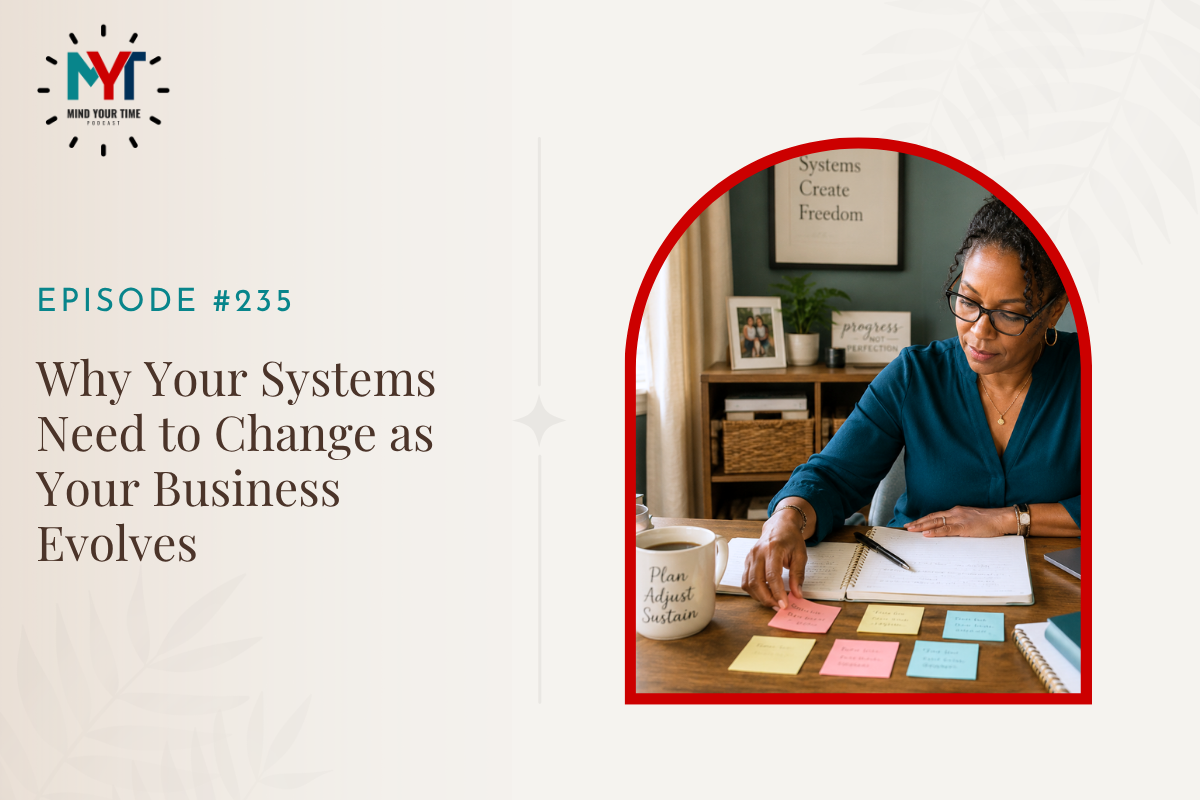
Prefer to listen? Check out Why Your Systems Need to Change as Your Business Evolves below.
If you would like to hear the expanded version check out the podcast episode below.
Related Episodes Mentioned:
Episode 230 – Why Stabilizing Your Business Operations Is a Leadership Move
Resources Mentioned:
Book a Legacy In Motion Session
 Personalized Support
Reach out at info@theshannonbaker.com to explore your next best step.
Let’s Stay Connected
Follow @mindyourtimepodcast and @the_shannonbaker on Instagram for conversations about boundaries, systems, and building a business that leaves room for your life.
The first question we usually ask ourselves should not be, "How do I fix this? We need to ask, "What has changed since I created this process? And I think it's a much more helpful place to start because it really reframes how we look at things. Welcome to the Maya Time podcast. I'm Shannon Baker, your coffee-loving host, business strategist, and systems expert, and I guide consultants toward systems that protect their time and elevate their expertise. So, if you're ready to run a business that supports your life and not the other way around, you're in the right place. Each episode shares grounded strategies rooted in my power in motion framework to help you lead your client experience with clarity and confidence. So grab a cup of coffee or your favorite beverage, and let's dive in.
Ever since our family moved into our new home about three months ago, I've been thinking more about how things change, and not necessarily a big change like the one that I just went through. But I'm talking about changes that happen over time, so you don't really notice it until one day something that used to feel very easily suddenly it feels harder. And even if it isn't harder, you don't get the same results that you used to. And the more I thought about this, the more I realize the same thing happens with our business processes. You can have a process that has worked for years, and then one day you find yourself scratching your head, wondering why has this stopped working all of a sudden? Right.
The first thing we usually assume if something is broken, but I've learned over the years that it's usually a sign that you and your business have evolved, but your business structure, including your systems, doesn't match where you are today. This reminds me of something that actually happened while we were unpacking the kitchen and the new home, before we moved, I had it all figured out. I knew exactly where my coffee station was going. I knew where my plates were going to go. I had mentally unpacked the entire kitchen before we even moved into the house. Actually, before the truck even parked in front of our house. Sounds simple, right? Well, as soon as we started putting things away, I realized that my plan was not going to work the way that I thought it would. I kept moving things around, thinking eventually I'd land on the perfect setup.
Guess what? That didn't happen, and it finally hit me. It wasn't that there was something wrong with my plan. It's just that my plan was designed for a completely different kitchen. So when my mom unpacked the first box, the dinner plates wouldn't fit into the cabinet. The mixing bowls that I thought would stack up nicely-they didn't-and suddenly I was standing in my kitchen, surrounded by boxes, thinking, "Well, now what? And to top it off, we have a tiny pantry, so it seemed like I was rearranging it every day because we couldn't find anything. I mean, I swear, I think I moved the ketchup like three different times before it finally ended up on the other side of the kitchen in a place that all of us could remember to get it. Even the canned sodas only fit in the pantry after I stacked the boxes together like a jigsaw puzzle.
Eventually, I realized that I wasn't searching for or trying to create the perfect kitchen. I was actually learning how to live in a different one. And by the end of the first week, I stopped trying to make it perfect and just wanted to stop opening the wrong cabinet every time I needed something. I think this is also something that happens in our businesses. We create systems based on what we know at that time, then we design them to support the business that we have at that time. If they're good systems, they service really well for quite some time, as long as we check them on a regular basis and make adjustments as needed, but then our business changes. Maybe we add a new service, or we stop offering something, or something in our life changes.
Whatever it is, the reality that we created things in those systems no longer support where we are today, but we keep expecting them to support this new version of us and the new version of our business, and that's where a lot of business owners get discouraged. They start questioning whether they created the the right process in the first place. Then they start looking for a new piece of software. Some wonder if they just need to burn everything down to start over. Sometimes the answer isn't throwing it all out and starting over, though. Sometimes it's as simple as moving the ketchup bottle. But the process isn't always the problem either.
The first question we usually ask ourselves should not be. How do I fix this? We need to ask what has changed since I created this process, and I think it's a much more helpful place to start because it really reframes how we look at things. So instead of looking for what's broken, we need to start looking for what has evolved or changed over time. One thing we tend to forget as business owners is things are constantly changing, and whether you are operating as a team of one or you have a small team, when things change in your personal life, you have to make changes in your business in response to that, not the other way around. Here's an example. Maybe when you started your business, working in the evenings wasn't a problem because your children were younger and they were in bed by 8o'clock And this was a great time for you to schedule emails for the next day after dinner, or do some client work because that's the season that your life was in, and that allowed that time for you to get work done.
Or today, maybe you're helping aging parents, so that means you've got doctor's appointments and caregiving responsibilities that require you to be available during the day, which wasn't required before. Or it could be that you hired a VA, or you stopped offering a specific service. Maybe you have fewer clients, but a few larger ones. Maybe you're making twice the revenue, and you have half the workload. Whatever the change is, I think this is where capacity becomes an important part of the conversation. Your personal priorities determine your capacity, and your actual capacity impacts how you run your business. That means your systems need to change to support the current season your life is in. And sometimes we spend way too much time trying to preserve the current version of the business that we built, and we forget to make room for the new version that it has become.
So, what version of your business are you protecting? It's very easy to forget that along the way we've become a different person too. We're always changing with every client, with every life experience, with every investment we make in professional development, it all sparks change. And this resistance, I don't think it's intentional, but it happens because we're told to just keep moving. We solve one problem, and we're automatically onto the next. So before we know it, we're still operating based on decisions that we made two, three, or five years ago, without evaluating whether or not that still makes sense. I remember working with a client who was totally convinced that she needed new software. She told me this system can't give me the reports that I need anymore.
So before we started looking into new software, I asked her to explain to me exactly what she was trying to do. And as we walked through it together, I realized the current software she was using wasn't the problem at all. She already had all the data that she needed, but the system wasn't set up to automatically pull everything together in a report the way she wanted. So instead of replacing the software, I mapped out a few adjustments of how it was being used, made the updates, and then she could get the reports she wanted, and some she didn't even realize that the software could give her. This is a perfect example of what happens when nothing is actually broken. Her business had evolved, but the way she was using the software hadn't evolved with it.
That's why we need to periodically step back and look at our business with fresh eyes, or better yet, have someone else do it for us or with us. One of the reasons that I started working with a podcast strategist is because I realized I'm a very good planner, but I didn't know anything about strategically planning and managing a podcast so that it could be both successful and sustainable. And that podcast strategist says something to me all the time. I will never forget these words. You can't read the label from inside the jar. Every time she says it, I'm reminded we all have blind spots. We're good at what we do. But it's much easier for us to see what's keeping someone else's business stuck than it is for us to see what's happening in our business.
That's why it's so important to periodically step back and evaluate whether the business that you're leading today is being supported by the systems that you built yesterday. This reminds me of a previous episode that I recorded about stabilizing your back office operations. In that episode, I talked about how your business quietly starts depending on you when the structure behind the scenes isn't keeping up with the business you're trying to lead. Sometimes stabilizing your business is not about creating something new. It's about recognizing that what once supported you now needs to evolve along with your business, and that's one of the reasons the first question that I ask during a legacy in motion session isn't "What's broken; it's what has changed.
And I love that question because it changes the direction of the conversation. When we start by looking for what's broken, our instinct is we need to fix it. But when we start by looking at what's changed, we slow down long enough to understand what we're really looking at and what we need to fix. A system needing attention isn't evidence that it failed. It's evidence that you and your business have evolved. And I don't know about you, but I'd rather have a business that evolves, not one that's still supporting a version of my life and business that no longer exists. So instead of seeing this as another thing on your to-do list. I want you to look at it as one of the ways that you care for the business that you've worked so hard to build.
Stop asking why isn't this working anymore, and start asking what has changed since I created it. Those two questions lead to very different conversations and outcomes. So here's something I'd love for you to think about this week. Don't open your project management software looking for something to update. Don't pull out all of your SOPs and start rewriting them. Just think about one process that's been frustrating you lately, and ask yourself a simple question: Has this process stopped working, or has my business changed since I created it? Then I want you to sit with your answer for a little while. You may realize the process doesn't need to be replaced at all. It may simply need a few tweaks so it can support the business and life you're living today.
Now let's take a minute to reflect on what we've talked about today. We started with a simple lesson from me unpacking my new kitchen. The plan I created before we moved it wasn't wrong. It just simply wasn't designed for the new space, and I think that's exactly what happens in business. We also talked about how our business naturally evolves over time. We add services, we refine our offers, we adjust our priorities, and the seasons of our life it changes. As those changes happen, our systems need to evolve right along with us. We also talked about our capacity. Your personal priorities influence your capacity, and your capacity should influence the way that your business operates. So, if your systems are still supporting a version of your life that no longer exists, they'll eventually start creating friction instead of giving you the breathing room that you need. And finally, we talked about asking a different question instead of immediately wondering what's broken and trying to figure out how to fix it, ask what has changed.
That one question will shift your focus away from failure to alignment, helping you make decisions based on the business that you're running today, not the one you started building years ago. If you've been noticing these changes in your business, that's exactly what the Legacy in Motion session is for. It's a different conversation than most people expect because we don't spend time looking at everything that's wrong with your business. We step back and look at what has changed over time. We look at how your business is operating today, whether your communication, your systems, and your workflows are still supporting the business that exists today, and then we look at where small changes could create more breathing room and make your business less dependent on you.
Sometimes the answer is not to create another system; it's simply about adjusting one that's already serving you well, so that it reflects where you are today instead of where you were a few years ago when it was created. That perspective alone can completely change the way you move forward, because you're making decisions based on the business where it is now. And not the one that you started building.
Thank you for tuning in today. If this episode feels like a breath of fresh air, it's because you're already craving a business that supports your life, not one that steals your time. If you want help spotting what's quietly draining your time and energy, you can download the Back Office Power Checklist at the Shannon baker.com forward slash checklist, and if this conversation resonated with you, make sure you're following the podcast on your favorite platform so you don't miss what's next. We'll keep breaking this down together one intentional step at a time. So until next time, keep calm and streamline.