There comes a point in many service-based businesses where things technically work, but only because you are holding everything together. Your clients are being served. Deadlines are being met. And nothing looks broken on the outside. And yet, inside, decision-making feels harder than it should. You are constantly thinking ahead, remembering details most of the time, and filling in gaps that should not require this much effort.
This is where the connection between business operations and leadership starts to matter more than most people realize.
Your business operations are not just tools or systems that work in the background. They quietly influence how you prioritize your time, how you respond to clients, and how confident you feel when making decisions. When your operations are unstable, you end up reacting instead of leading intentionally. Choices get made based on what is urgent instead of what actually matters, especially your true capacity.
If this feels familiar, it does not mean you are doing something wrong. It usually means your business structure is asking too much of you. When everything depends on your availability and memory, your capacity gets stretched thin. That’s why stabilizing your business operations is not about perfection. It is about creating a structure that supports clear thinking and sustainable growth over time.
How Unstable Operations Shape Your Daily Decisions
When your business operations are unclear or inconsistent, you start compensating without even noticing. You answer messages at all hours. You keep important details in your head. You manually handle things that should already have a process and be automated. From the outside, it looks like dedication. On the inside, it slowly drains your energy.
This is especially common among consultants and high-touch service providers who care deeply about their clients. You want things done well, so you step in all the time. You smooth things over. You make it work. Over time, that becomes the default way of operating.
In this kind of environment, business operations and leadership become tightly connected in unhealthy ways. Decisions get delayed because change feels risky. Delegation feels harder than doing it yourself. You stick with what feels predictable, even when it is exhausting.
Eventually, you start choosing what feels manageable instead of what is truly necessary. Growth slows down. Frustration builds. Not because you lack skill, but because your structure is not supporting you the way it should.
Clarity does not come from pushing harder. It comes from seeing where things are missing and how that affects your ability to lead your business well.
Stabilizing Your Business Without Overhauling Everything
Many people think stabilizing their operations requires a massive cleanup project. Something they will get to later, when things calm down (which never happens). In reality, it is one of the most important decisions you can make as a business owner.
When you understand how business operations and leadership work together, your approach starts to change. You stop trying to fix everything at once and you start making changes with awareness.
You notice where things only work because you are constantly available. You see where you are the system. You recognize which parts of your business rely on effort instead of structure.
That awareness creates space. Space to think more clearly. Space to make better decisions. Space to lead without feeling like everything depends on you.
At this point, many business owners benefit from an outside perspective. When you are inside your business every day, it is hard to see what is really happening. This is often when clients come to me for a Legacy In Motion Session. They are not looking for more advice or another program. They want space to slow down, look at the full picture, and talk through what is really going on with someone who understands how their kind of business works.
Someone looking at it with you can often spot patterns and pressure points much faster than you can on your own. Together, we look at how your back office operations depend on you, how decisions are being made, and where unnecessary pressure is coming from.
When your business operations start supporting you instead of depending on you, your role changes. You are no longer constantly reacting. You are making decisions with more confidence and intention. That is what sustainable leadership looks like in real life.
If you would like to hear the expanded version check out the podcast episode below.
Related Episodes Mentioned:
Resources Mentioned:
👩🏽💻Book Your Legacy In Motion Session:
A live, virtual clarity and decision-making session where we talk through what’s really happening in your business together. It’s designed for moments when you know something needs to change, but you don’t want to guess your way forward. You’ll step back, look at the full picture, and decide what actually needs to shift, without rushing into fixes or adding more to your plate.
📩 Personalized Support
Reach out at info@theshannonbaker.com to explore your next best step.
Let’s Stay Connected
Follow @mindyourtimepodcast and @the_shannonbaker on Instagram for conversations about boundaries, systems, and building a business that leaves room for your life.
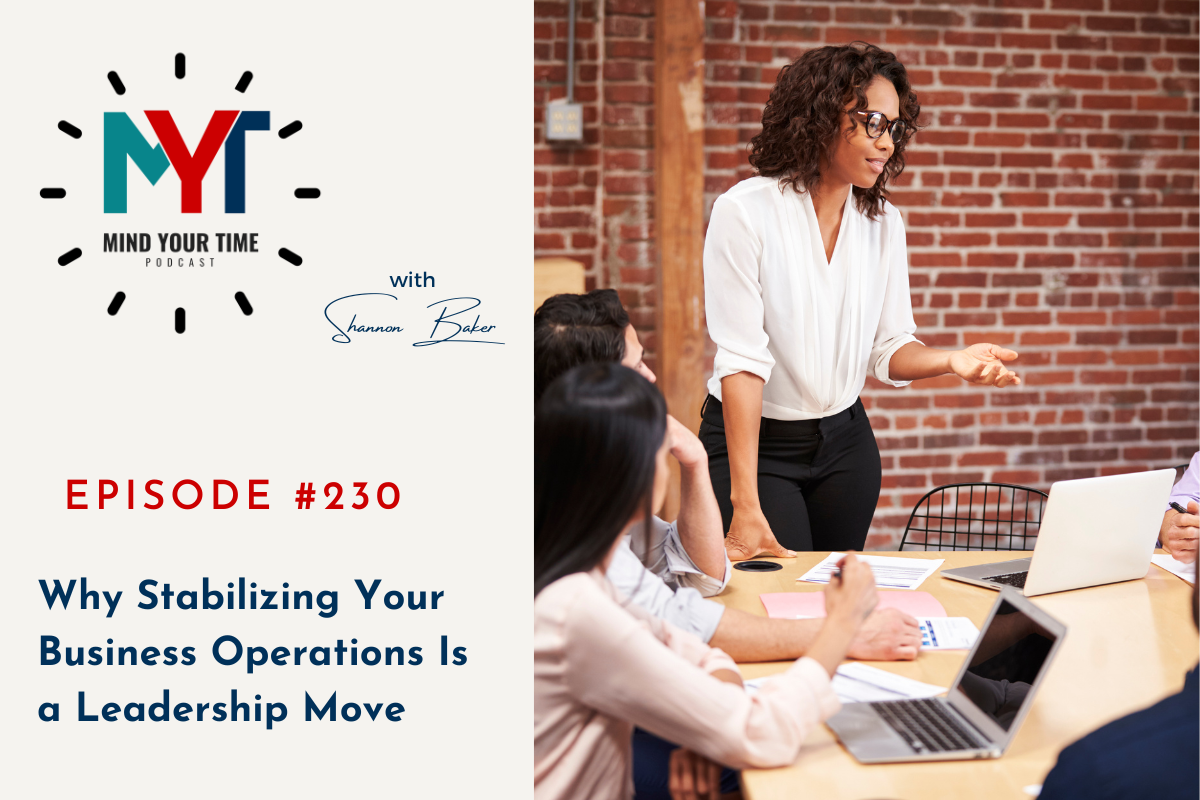
If you have been telling yourself you're going to clean things up later when you have more time, this episode is for you. Because stabilizing how your business runs, it's not cleanup work that you squeeze in when things slow down. It's a leadership decision. When the back end of your business is unstable, it quietly shapes how you make decisions, what you prioritize, and how much you carry on your own, even when nothing is obviously broken. Tune in to hear what changes when your business supports you instead of depending on you.
Welcome to the Mind Your Time Podcast. I'm Shannon Baker, your coffee-loving host, business strategist, and systems expert, and I guide consultants towards systems that protect their time and elevate their expertise. So if you're ready to run a business that supports your life and not the other way around, you're in the right place. Each episode shares grounded strategies rooted in my power and motion framework to help you lead your client experience with clarity and confidence. So grab a cup of coffee or your favorite beverage and let's dive in.
There's a moment I've seen many business owners reach where everything technically works, but only because they're holding it all together. I call this duct taped operations. Your clients are being served, work gets delivered mostly on time, and nothing is obviously broken, but everything requires constant attention from you. Remembering, checking, following up, filling gaps that shouldn't require this much effort. And over time, that starts to shape how decisions get made.
In the last episode, we talked about how good business decisions start with your capacity. Today, I want to apply that train of thought to something many leaders quietly postpone until they have time, and I say that in air quotes, your back office operations. For a lot of people, back office operations feel like cleanup work that they can eventually get to, something you can handle later when things calm down, once you have more time, once the business feels less demanding. Most of the time, none of these actually come true. And yes, I know cleaning up your back office and creating systems isn't sexy or fun, but the truth is, stabilizing your operations is not cleanup work, it's a leadership move.
When your back office operations are unstable, your leadership becomes reactive by default. Decisions are made based on what needs immediate attention, which is constantly changing, and then you look for what is easiest to fix or what is loudest at the moment. It's almost like a newborn baby. But that doesn't mean that you're a poor leader. It means that your business structure is asking too much of you. And this is something that I constantly see among high-touch service providers, consultants, virtual assistants, managers, anyone that's deeply embedded in their clients' work.
This happens because you care deeply. You want to do good work. You want your clients to feel supported, so you overcompensate. You respond quickly no matter what day it is or what time it is. You hold all the details in your head, you smooth over unclear expectations, and you step in because you want to keep things moving. On the outside, this looks like dedication and top-notch customer service, but behind the scenes, it is slowly draining your capacity and wearing you out.
When too much depends on you, it becomes harder to see your options clearly. You avoid making changes because it feels like there is no space to manage the transition. You delay delegating because it feels easier to just handle it yourself, and you keep things as they are because they feel predictable, even though you know it's unsustainable. When your back office operations stop supporting you, they start affecting how you lead, and stabilizing your operations changes that.
This is not about making things perfect, and you don't have to implement everything at once, but you do need to reduce the amount of effort that you have to put in just to keep things running. One pattern that came up clearly in a recent conversation I had with another business owner was this. Most people are not actually looking for systems, they're looking for relief. They want a way to stop being on all the time, a way to stop holding everything in their head, and a way to stop being the default person to answer every question.
You may not use the word operations or systems, but you feel the impact of that operational instability every single day, when your clients reach out at all hours, when information is sent to you late, when your work requires constant clarification, and when boundaries were never clearly set and now everything feels urgent. Those experiences are not separate from your operations. They are the result of how your business is structured or not structured.
Stabilizing your operations is about deciding that your business should support you, not rely on you to survive, and that decision alone is leadership. It requires you to step back far enough to see where responsibility sits, where decisions get stuck, and where your capacity is being quietly consumed. This is often the moment when leaders realize that effort isn't the issue, because they're already showing up, delivering, and doing the work.
At this point, clarity comes faster when someone outside of your business helps you look at what is really going on. You want clarity about how decisions are flowing, where boundaries are unclear, and what actually needs to change and what doesn't. This is also the kind of aha moment a Legacy In Motion Session is designed for, not when everything is falling apart, but when nothing feels settled and you don't feel supported.
When you know the way your business is functioning is no longer sustainable and you don't want to guess your way forward, it's time for a Legacy In Motion Session. It's a space to slow down and look at the whole picture, where we look at how your back office operations depend on you, how decisions are being made, and where unnecessary pressure is coming from. It's not ongoing support, it's not execution, and it's not about adding more to your plate.
It's about deciding differently so stability comes from structure instead of constant effort, and that distinction matters. Because when your business operations are stabilized, the way you lead changes. You're not constantly reacting or carrying everything alone, and you're not making decisions in isolation while you're trying to keep everything working. You have space to think, choose, and lead intentionally.
This doesn't require a full overhaul of your business. It starts with awareness. Take note of where you're overcompensating, where you are the system, and where things only work because you're available, responsive, and remembering everything. These are not personal shortcomings. They are signals that your business operations need attention, not later, but right now.
Before you move on with your day, take two minutes and write down one place in your business where things only work because you are available, responsive, or remembering everything. Do not fix it. Do not clean it up. Just notice it, because that is your starting point.
Now let's take a moment to review what we've talked about today. First, stabilizing your back office operations is not cleanup work you get to keep putting off. It is a leadership decision that shapes how you show up every single day. Second, when your business operations depend too much on you, your leadership becomes reactive instead of proactive, making it harder to make sound decisions. Third, this is not about working harder or fixing everything at once, but about noticing where you're overcompensating and holding things together through effort instead of structure.
We also talked about what happens when your back office operations stop supporting you. They affect how you lead, influence your boundaries, your decision making, and your capacity more than you realize. Not to mention, clarity comes from slowing down long enough to see how your business is actually operating, not from pushing forward and hoping things settle on their own. That is the shift I'm inviting you to make today.
If this episode helped you see that your business doesn't need more effort or energy, but it does need steadier structure and clearer decisions, the Legacy In Motion Session is available when you're ready. It's a focused space for you to step back so we can see what is actually happening and decide what needs to change without rushing into quick fixes. You can find the link to book that in the show notes.
For now, remember that you do not need to clean anything up. You can simply notice where stability would change how you lead and let that awareness guide what comes next.
Thank you for tuning in today. If this episode feels like a breath of fresh air, it's because you're already craving a business that supports your life, not one that steals your time. If you want help spotting what's quietly draining your time and energy, you can download the Back Office POWER Checklist at theshannonbaker.com/checklist. And if this conversation resonated with you, make sure you're following the podcast on your favorite platform so you don't miss what's next. We'll keep breaking this down together one intentional step at a time. Until next time, keep calm and streamline.